
Improving Tree-sitter's GLR Algorithm and Memory Layout
Part 3 of 4 — simplification and performance
The previous post ended with a Rust runtime I could finally reason about. That made it safe to return to performance, but not to repeat /goal improve the perf by 20%. This time I asked ChatGPT to trace one expensive operation at a time and show which allocation, ownership transfer, or traversal could disappear.
I began with reduction: the moment when the parser replaces several recognized pieces of syntax with their parent. Reduction sits at the boundary between two structures that both contain things called “nodes.” On one side is the temporary GLR stack graph, which remembers possible parse histories. On the other is the syntax tree being built for the caller. Following one reduction through both structures gave the rest of the investigation a path.
The stack produced the clearest result. In the seven-language performance corpus, 98.898% of released graph nodes had one predecessor. Keeping that common history linear until GLR behavior was actually needed improved the geometric mean by 9.01%. Syntax storage was less obedient: compact arena-backed references survived the experiments, but no isolated “arena speedup” did.
At the combined parser checkpoint, Rust was roughly 30% faster than C—yet ast-grep became slower than its C-backed build. This post follows the parser-side investigation: why a graph was built for a line, why delaying it worked, and why “use an arena” became several separate decisions. The final post takes the apparent parser victory into the application-level failure that overturned it.
One reduction connects the stack graph to the syntax tree
The previous post explained LR and GLR in detail. The compact recap is that LR selects shift, reduce, or accept from (parse state, lookahead) and advances one stack; GLR preserves multiple valid actions as stack versions that share a graph-structured stack.
An ordinary LR parser has one current stack. Tree-sitter's GLR parser can have several current possibilities, called versions. Each version has a StackHead, but copying a version does not copy its complete history. The heads point into a shared graph of StackNodes instead.
Each StackNode records a parse state and input position. A backward StackLink identifies a predecessor and carries the Subtree recognized on that transition—either a token leaf or a reduction-created internal subtree. This makes one distinction essential:
- the stack graph remembers possible parser histories;
- the subtree graph contains the syntax those histories have built.
The generated parse table drives both. A shift recognizes one token and pushes its leaf subtree. A reduce walks backward over one or more links, collects their subtrees as children, builds an internal subtree, and pushes it in the corresponding goto state. If several actions or pop paths are valid, the runtime retains several versions. Compatible versions can merge when state, position, error cost, and external-scanner state permit the same continuation; their incoming links preserve the distinct histories.
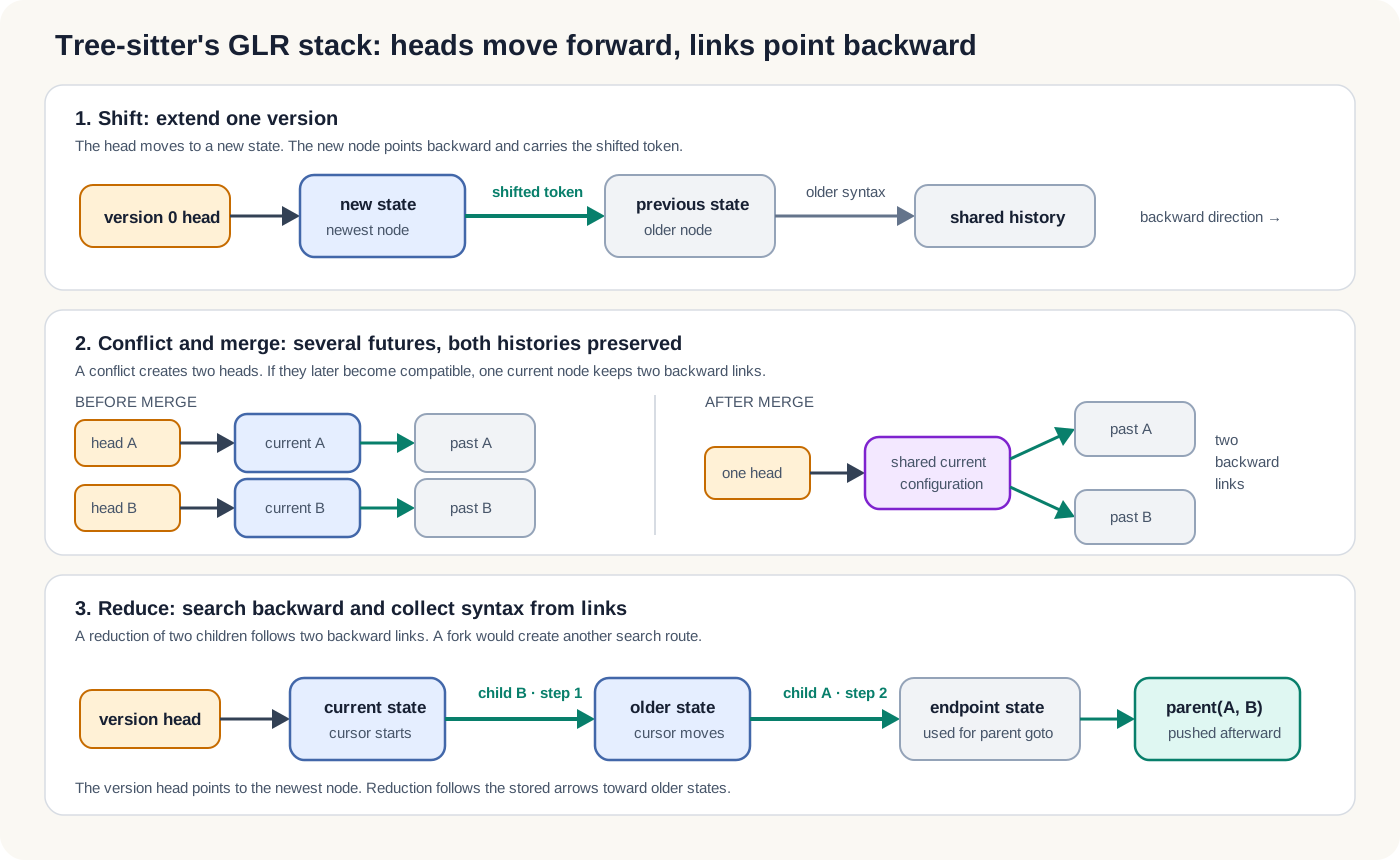
Rejected versions are not merely removed from a list. Releasing their heads can release an entire private stack history and the speculative subtrees stored on its links. Shared history survives because another head or link still owns it.
Now follow one concrete reduction. Start with a stack version whose parse table says to reduce two children. Its StackHead points to the current StackNode. The links below that node contain the recent syntax and lead toward older parser states.
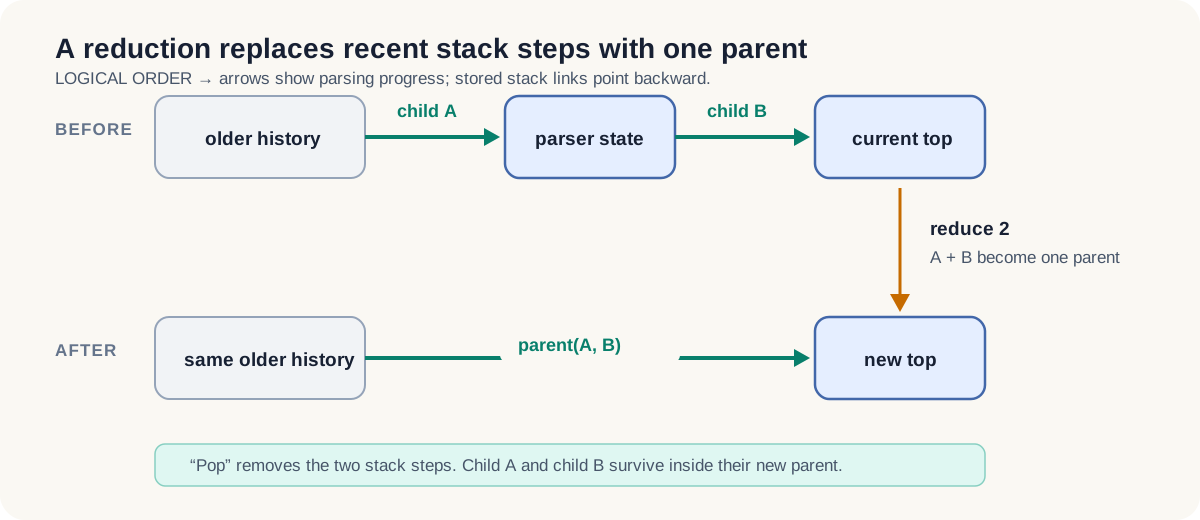
The diagram shows the logical stack from older to newer. In memory, Tree-sitter stores the links in the opposite direction so a reduction can walk backward from the current top.
Suppose the grammar says to reduce two children. Tree-sitter starts a DFS pop cursor at the version's current node. The cursor holds the current stack node, the accumulated child handles, and the remaining grammar-child count. It follows two links backward, collects the subtrees carried by those links, and stops at the predecessor state underneath them.
If a node has several backward links, the history has forked. Tree-sitter copies the cursor and follows every route. Each completed route produces its own temporary stack version. The parser builds a parent from that route's children, looks up what state should follow that new parent, and pushes it. Compatible versions can then merge again.
The pop path retained every collected child before releasing the old stack links, so each child survived the ownership transfer into its new parent. On a single linear path, those reference-count operations were a compensating increment and decrement; on a branching pop, they were required for correctness.
This is why the generalized machinery exists. If histories really fork, the DFS cursor must explore them, their results must continue as separate versions, shared syntax must stay alive, and compatible versions may later merge. Every part has a job. The allocation question was whether every part needed to appear before a fork existed.
The allocation profile found a graph waiting for a fork
I instructed ChatGPT to distribute the parser's allocation costs by mechanism. The instrumented Rust runtime parsed all 40 files in the seven-language performance corpus with one validation parse and one measured parse per file. The counters covered both passes; percentages and means describe the same complete corpus. The audit pointed first at the GLR stack:
| Observation | Result |
|---|---|
| Logical stack nodes created | 1,139,623 |
| Released nodes with one predecessor | 98.898% |
| Mean predecessor-link count | 1.011 |
| Unused inline link-slot writes | about 127.4 MB |
Now the numbers had a mechanism behind them. A node with one predecessor offers one route backward. 98.898% of released nodes had exactly that shape, and the mean was only 1.011 links per node. These were shape counters, not a claim that 98.898% of CPU time was deterministic. They showed that, within the measured released-node population, the generalized representation was overwhelmingly carrying linear history.
That meant the ordinary reduction still paid for the entire generalized journey:
- the DFS cursor was created but never copied;
- retaining the children and later releasing their old links produced a
+1followed by-1; - one temporary version was created, moved back into the original version's array slot, and removed;
- the parser checked for another version to merge with, but none existed; and
- the parent was pushed through a 160-byte graph node with room for eight histories, while using one.
The 127.4 MB of unused link-slot writes was the physical receipt: records prepared room for alternate histories that never arrived. Tree-sitter was carrying mountaineering equipment through an airport because there might eventually be a hill. This number is cumulative write traffic across both corpus passes, not memory held at one moment.
The machinery was correct. It was simply arriving before ambiguity or recovery needed it. Once that connection was visible, the 160-byte stack node stopped looking like a respectable data structure and started looking like evidence.
The audit also changed how I directed the AI. Earlier prompts had asked for performance and received plausible local optimizations. Now I could name the work to remove: the unbranched search, the canceling ownership operations, the temporary version, the empty merge check, and the mostly unused graph record.
I asked ChatGPT to shrink each graph record, attach a cheaper linear tail, specialize the reduction path, and reuse the search's temporary storage. Each made some part of the journey cheaper while keeping the journey. The benchmark was unimpressed.
That changed the question from “How cheaply can the common case use the graph?” to “Why should the graph exist before the parse branches?”
The literature offered a principle, not a patch
At this point I instructed ChatGPT Pro to survey GLR research. Most of the ideas were less new than expected. The messy /goal improve the perf by 20% phase had already tried rough versions of many of them. Others required changing grammars, generators, or generated parsers, which would break the rule that existing Tree-sitter languages must continue to work unchanged.
The review was still useful because it removed dead ends. It gave names to old experiments, separated runtime ideas from ecosystem-wide redesigns, and left one principle that fit both the profile and the product boundary.
The useful principle I took from Elkhound was lazy structure: use the cheapest representation that matches the parser's current reality. Build the generalized representation only when ambiguity makes it necessary, then return to cheap execution when the ambiguity ends.
This was different from putting a fast branch inside the old GLR operation. A fast branch still allocates the graph object and enters its ownership machinery. Lazy structure means that work never begins.
The literature supplied the principle; the profile supplied the reason to trust it. Nearly 99% of the measured stack nodes had only one way backward. The common case was not a simpler graph. It was not a graph yet.
The deterministic window: delay the graph
I instructed ChatGPT to keep recent, unambiguous parser progress in a compact linear list. I called that list the deterministic window. The complete GLR graph still existed underneath it, ready for the cases that genuinely needed branching.
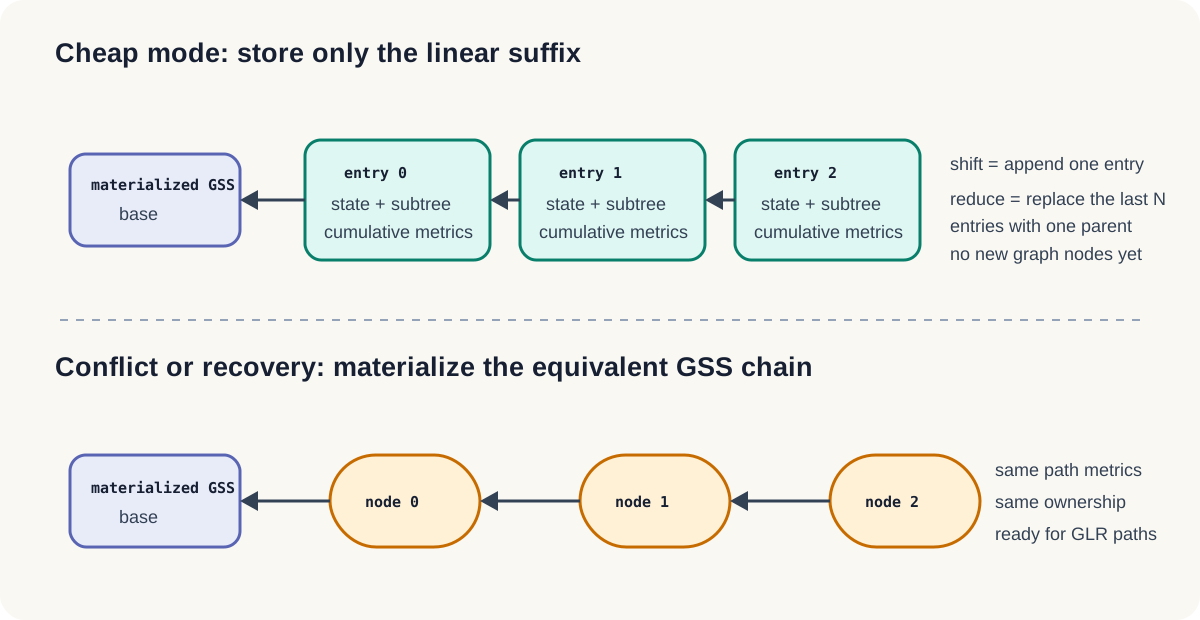
While there is only one active version to advance:
- a shift appends one compact window entry;
- an eligible reduction moves the top
ksubtree handles into their parent and replaces that suffix with one goto-state entry; and - no
StackNode, DFS pop cursor, temporaryStackHeadversion, or merge probe is created.
The compact record happened to be one quarter the size of the eager graph node, but size was not the main idea. The important saving was the lifecycle that never happened: no graph allocation, no temporary version, and no compensating retain/release pair.
When a multi-action cell, recovery, acceptance, stack-version mutation, or graph traversal appears, the parser expands the list into the same graph it would previously have built eagerly and continues through the existing GLR implementation. Syntax-tree construction does not change. Parsing rules do not change. Only the time at which the parser pays for its generalized history changes.
That distinction made the design tractable. This was not a second parser with similar behavior. It was the old parser with delayed representation.
The safety rules were deliberately boring
The first version followed three conservative rules:
- Stay linear only while there is exactly one active, non-error stack version.
- Before a multi-action cell, acceptance, recovery step, stack-pop traversal beyond the window, version mutation, or diagnostic logger, build the complete graph and use the existing code.
- When ambiguity disappears, begin another empty linear window instead of trying to compress the old graph retroactively.
Anything not explicitly proven safe took the old path. That left some possible speed on the table, but produced a much better failure mode: an unsupported case became ordinary GLR execution, not a new kind of wrong parse.
It also avoided a tuning heuristic. Mostly deterministic languages keep long, cheap windows. Conflict-heavy languages create short ones and naturally behave more like the old parser. No guessed threshold decides whether a grammar is “worth optimizing.”
Finally, delayed work must remain exactly equivalent to eager work. Debug builds checked that expanding a window reproduced the same parser state and saved path metrics—position, error cost, node count, and dynamic precedence—and that subtree ownership moved once at each boundary. Those details belong in the appendix; the governing principle is simpler: postpone the representation, never the correctness.
The deterministic window improved parsing by about nine percent
I asked ChatGPT to run a paired same-session A/B benchmark with window entry enabled and disabled. It used seven languages, five repetitions, and a 200 ms minimum fixture sample time:
| Language | Throughput change |
|---|---|
| C++ | +2.04% |
| Go | +2.54% |
| Java | +4.22% |
| JavaScript | +13.17% |
| Python | +11.99% |
| Rust | +14.38% |
| TypeScript | +15.72% |
| Seven-language geometric mean | +9.01% |
This was an implementation gate, not a universal nine-percent claim: some fixture samples were noisier than the later publication threshold. Still, every language improved, and the combined result was well beyond the observed pair noise. I instructed ChatGPT to repeat the correctness, recovery, ownership, and forced-materialization checks. They held, so the implementation stayed.
The result succeeded where the local shortcuts had failed because it removed the generalized phase from the common path instead of making that phase a little cheaper. A GLR parser may need a graph eventually; it does not need to represent its entire life as one. The linear case deserves a linear physical representation.
Once the graph quieted down, syntax storage took the profile
The deterministic window removed most stack-graph allocation from the common path. A new profile left syntax-node creation as the largest remaining source of allocator traffic. Every reduction still created an internal syntax node, and at this checkpoint each one owned an independent variable-sized allocation. Storage—not parser control flow—became the next target.
The next instruction sounded beautifully precise:
Put heap-backed subtrees in one contiguous arena and refer to them by index.
The experiment history did not preserve a clean Rust pair for either per-node allocation versus a direct-pointer arena or direct pointers versus arena-relative indexes. I therefore cannot assign a standalone throughput gain to “the arena” or “the index.” The arena amortized allocator calls and enabled the later handle and ownership designs; those later changes were measured individually.
Several conversations later, this turned out to be four nouns wearing a trench coat.
An arena says where allocations share storage and lifetime. It does not decide whether references are pointers or indexes, whether records move, where children live, how sharing is detected, or what happens when the tree is returned to its caller. I had initially asked ChatGPT for one answer. Useful progress began when I separated the decisions.
I can give away the design that survived before visiting the wreckage. One growable allocation holds many syntax records. Compact four-byte tagged arena offsets name them. An internal node keeps its child handles beside its own record. Sharing is tracked differently while parsing than after the tree is returned to its caller. The failed experiments below explain why every clause of that design exists.
“Use an arena” was not one design axis
For this runtime, the arena question separated into six decisions:
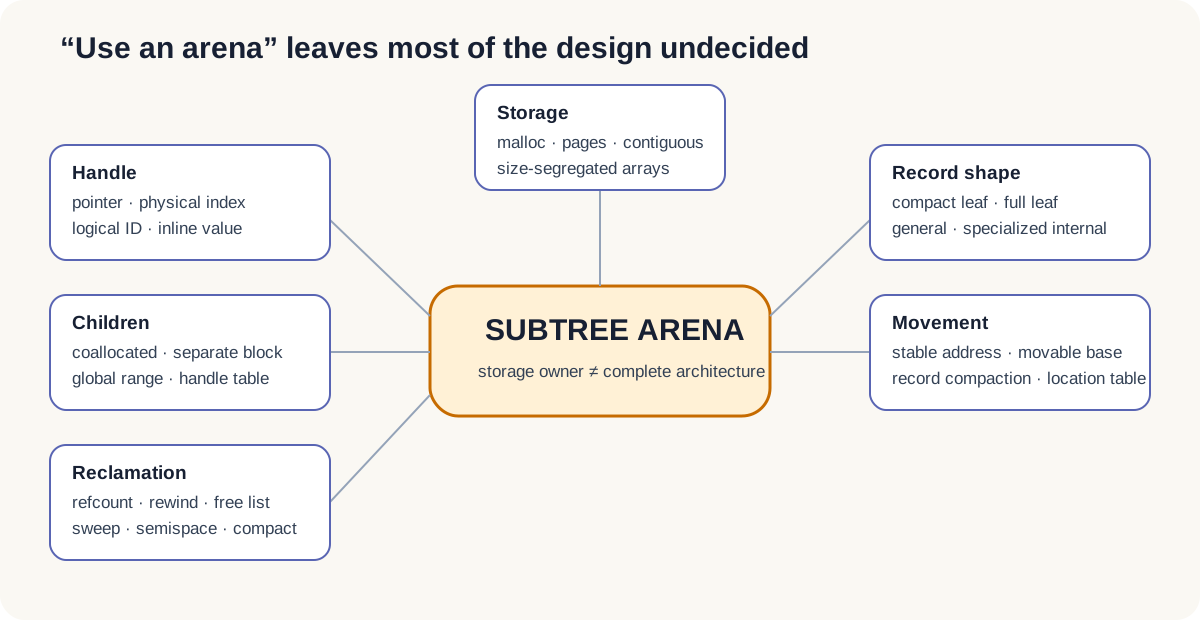
Handle — How does the parser refer to a syntax node? Handles are copied through the parser stack and stored in a parent's child list, so their size and lookup cost are both hot. Possible designs: direct pointer, physical arena index, stable logical ID, or an inline-or-index value.
Storage — Where do the node's actual bytes live? The handle only names a node; its record still needs an allocation that owns the symbol, size, flags, and other metadata. Possible designs: per-node allocation, stable pages, one contiguous arena, or size-segregated arrays.
Record shape — What exactly is stored for one node? A token leaf and an internal parent need different information, so one universal record may waste space on the common case. Possible designs: compact and full leaf records, one general internal header, or kind-specialized internal headers.
Children — Where does a parent keep its children? An internal node owns a variable list of child handles, and their location affects both construction and later traversal. Possible designs: coallocated prefix, separate block, global child range, or logical handle table.
Movement — What is allowed to move? Growing one allocation may move its base; compaction may also move individual records inside it. A design must say which movement its handles can survive. Possible designs: permanently stable addresses, a movable base with relative indexes, physical-index rewriting during compaction, or stable IDs resolved through a location table.
Lifetime — When can memory be reused? A dead node may release its own storage immediately, or its bytes may remain until a larger storage region is reclaimed. Possible designs: reference counting, bulk arena rewind, free lists, mark-sweep, or semispace copying.
These decisions are separable but coupled. Handle form constrains movement; child placement affects locality and reclamation. The experiments therefore varied one primary decision at a time while minimizing the collateral representation changes. The handle came first, because a growable contiguous allocation is useful only if its references survive growth.
The original C runtime had already made one coherent set of choices. Its eight-byte Subtree either contained a compact leaf directly or held a stable pointer to one heap allocation. Full leaves used a small reuse pool; each internal parent owned one allocation containing its child handles immediately before a general heap header. Atomic reference counts reclaimed those allocations individually and also guarded copy-on-write mutation. Because addresses never moved after construction, direct pointers remained valid for the node's lifetime.
Indexes enabled movement; they did not create throughput
The conservative candidate kept the existing eight-byte handle. That value either contained a small token leaf directly or pointed to a larger record. Small leaves remained unchanged; only the pointer to a larger record became a byte offset from the start of the arena:
heap_address = arena_base + indexThis allowed the allocator to move the complete arena block while growing it without invalidating references. It did not make record access faster. A pointer already held the final address; an index required adding the arena's current base address first.
The direct-pointer arena and this indexed endpoint were not preserved as a paired Rust benchmark, so there is no clean index-versus-pointer throughput delta. The available measurements provided no evidence that the index improved throughput. I retained it as relocation infrastructure, not as a speedup.
That conclusion mattered because the upper 32 bits of the handle looked available. I instructed ChatGPT to pack frequently read metadata there—symbol, child count, and flags—so reduction might avoid resolving the arena record. Two screens against the immediately preceding Rust revision used the nine reduction-heavy Go and Java fixtures. The packed version lost every fixture: -2.31% and -2.76%, averaging -2.54%. I rejected it before the full forty-fixture gate.
The packed handle duplicated truth without removing the second memory lookup. Internal nodes still needed padding, size, error cost, precedence, descendant counts, scanner flags, repeat depth, and children from their records. The new path added masks, coherence work, and register pressure. Thirty-two empty bits were available. Thirty-two free bits were not.
The narrower follow-up worked. While a reduction combined its children's metadata, the runtime looked up each record once and kept a temporary local view. The stored record remained the single source of truth. That improved the forty-fixture geometric mean by 2.04% over the preceding index-only Rust implementation. With repeated resolution out of the hot loop, the next question was how much handle data the parser needed to move in the first place.
Four-byte handles changed the amount of data moved
The denser candidate made every Subtree a four-byte tagged, arena-relative byte offset:
0                              null
(byte offset | 1)              compact 8-byte leaf record
nonzero even byte offset       full leaf or internal record

record address = arena base + (handle & !1)
The tag does not describe the child's grammar type. It distinguishes two physical record layouts. A compact leaf is an eight-byte packed record; full leaves and internal nodes begin with the larger common heap header. An accessor must know which layout it is reading before it interprets those bytes.
The runtime could load a tag from the arena record instead. That would add a dependent memory read to hot operations such as reading a symbol or size: first resolve and inspect the record, then choose the layout and read the requested field. The handle already has a free low bit because every record offset is aligned, so carrying the layout answer there avoids that preliminary load. Full leaves and internal nodes share the common header and are distinguished after it is resolved.
Compact leaves still existed, but their eight-byte payload moved from the handle into the arena. The parser paid an extra lookup when reading one. In exchange, every stack payload and child array moved four bytes per subtree instead of eight.
Internal children remained coallocated with their parent:
[u32 child handles][alignment padding][internal header]The internal header is the fixed-size record for the parent syntax node. It stores facts such as the parent's symbol, size, flags, child count, and summary metadata. The child list is variable-sized, so it sits immediately before that header.
Coallocated means the arena reserves both parts as one block: the child handles first, followed by the parent's header. The children are still separate syntax nodes; only their handles are stored beside the parent metadata. One allocation cursor advance therefore creates the complete parent record, and later code can reach its children without following a pointer to another allocation.
The reduction path could still move its finished child buffer directly into the parent's final storage. Against the preceding eight-byte indexed-handle implementation, the paired benchmark measured +1.88% across the forty-fixture geometric mean. Six languages improved; TypeScript's -0.23% remained within ordinary run-to-run variation. The four-byte handle stayed.
The tag does not halve the addressable arena. Record alignment already makes every valid byte offset even, so the low bit carries the record-kind tag without discarding an otherwise usable offset bit. The handle therefore covers almost the complete 4 GiB u32 byte-offset domain. A wider offset would not improve locality, throughput, or resident set size (RSS), the process's resident pages. A wider offset can be revisited when a real input reaches the limit, not when a larger number becomes emotionally appealing. The handle width was settled; the location of the handles inside each parent was not.
The children rejected a cleaner address
Keeping children beside their parent makes later reuse of individual blocks awkward, so I asked ChatGPT to try one global child-index array. Each internal record would store the beginning and end of its section in that array instead of keeping children beside its header.
The first version unfairly copied temporary children into final ranges and inflated peak RSS. The corrected version reserved exact final ranges for deterministic reductions; only branching GLR reductions used temporary buffers. Memory recovered. Throughput did not. The serious implementation regressed 2.72% across the forty-fixture geometric mean, with Go, Java, Rust, and C++ losing more than four percent each.
The common path had exchanged one local [children][padding][header] construction for two storage reservations, distant pages, and another address calculation during traversal. The cleaner lifetime layout was a worse access layout. I rejected it and instructed ChatGPT to restore coallocation. That settled where children lived. It did not settle what the runtime should do when branches stopped owning them.
Removing reference counts produced a magnificent wrong answer
The arena changed what a reference count could accomplish. When a count reached zero, the record's bytes still could not be returned individually; the arena reclaims storage as a whole. But the count had another job that remained essential: it told Tree-sitter whether a syntax node had one owner and could be modified in place. A shared node had to be copied first.
The first experiment preserved only that second job. ChatGPT replaced the count with a sticky shared bit: once a node gained a second owner, it remained marked as shared, and releasing an owner did nothing. Removing the count updates appeared to improve parse throughput by 8.28% across the forty-fixture geometric mean. Then the timeout test failed.
The GLR stack had shared some nodes only temporarily while it explored competing parses. After losing branches were discarded, the accepted tree could be the sole owner again, but the sticky bit still remembered the earlier sharing. Tree-sitter balances deeply repeated syntax before returning the tree, and that pass may modify only uniquely owned nodes. Too many nodes looked shared, balancing skipped work it needed to perform, and the stress case timed out. The impressive benchmark had measured a parser that was avoiding required work.
ChatGPT then walked the accepted syntax graph and reconstructed which nodes were actually shared before balancing. Correctness returned, but the version that kept atomic sharing markers throughout parsing measured -0.32% against the exact atomic-reference-count control. Removing the counts alone was not a safe throughput win.
That failure exposed a better boundary. During parsing, the arena belongs to one parser thread, so its nodes use cheap Cell<bool> sharing markers and rejected branches do not trigger per-node release cascades. Before balancing, the accepted-graph walk restores the exact sharing information that mutation needs. After the tree is published and may cross threads, each node switches to a relaxed AtomicBool copy-on-write marker, while one atomic owner count keeps the complete arena allocation alive.
This phase-specific design improved parse throughput by 3.35% against exact atomic reference counting, with no meaningful change in peak RSS. It removed thread-safe bookkeeping from the private parse phase without weakening the uniqueness check. Individual dead records still occupied arena space until the complete allocation was released, however. That left one final lifetime question: should a collector recover those holes?
Garbage collection arrived before there was garbage worth collecting
Four-byte tagged offsets made a moving collector possible in principle. I instructed ChatGPT to implement the simplest copying-collector experiment, often called semispace collection: after a successful parse, copy the accepted tree into fresh space, rewrite its indexes, and discard the old parser-private arena.
All tests passed and both versions produced identical trees. The forty-fixture geometric mean regressed 37.45%, and peak RSS rose while the old and copied trees coexisted. The benchmark deleted each tree before the next parse, so the control could already rewind the complete arena. The collector copied every live syntax occurrence and reclaimed nothing useful.
Negative 37.45% is not a subtle hint. It is a benchmark clearing its throat and asking everyone to leave.
This did not prove that collection could never help a conflict-heavy or long-lived workload. It proved that unconditional publication-time copying was the wrong schedule. Copying every tree just as it was returned to the caller needed evidence of actual dead-space pressure, not a theoretical invitation from the index format.
Where the arena landed
After all of those branches, the retained design was concrete:
- one allocation starts small, grows on demand, and holds many syntax records;
- every subtree is named by a four-byte tagged arena-relative offset;
- a parent's child handles stay beside the parent for locality;
- reduction looks up each child's metadata once instead of repeatedly;
- sharing uses parser-private
Cell<bool>markers, then publishedAtomicBoolmarkers; and - no garbage collector runs on the fresh-parse path.
Here is the final comparison against the original C representation:
| Design decision | Original Tree-sitter | Retained arena design |
|---|---|---|
| Handle | Eight-byte inline-leaf-or-pointer value | Four-byte tagged arena-relative byte offset |
| Storage | Compact leaves in the handle; one heap allocation per full leaf or internal parent, with a small pool for reusable leaf records | One growable arena allocation containing compact leaves, full leaves, and internal parents |
| Record shape | Compact leaf in the handle; one general heap header with variant storage for internal-node or full-leaf data | Eight-byte compact-leaf record; specialized internal and full-leaf records after a common heap header |
| Children | Eight-byte child handles immediately before the parent's header in the same allocation | Four-byte child handles immediately before the parent's header in the same arena block |
| Movement | A completed heap node has a stable address, so its direct pointers remain valid | The private arena may move while growing; relative offsets remain valid. A published arena no longer moves |
| Lifetime | Atomic per-node reference counts establish uniqueness and recursively free or pool unreachable records | Parser-private sharing markers, exact accepted-graph reconstruction, published copy-on-write markers, and one owner count for bulk arena lifetime; no collector |
There is no honest single “arena speedup” to print beside that list. The history contains no paired evidence that indexing alone improved throughput; each later experiment compared against the Rust revision immediately before it. The evidence supports the individual choices, not an invented sum of their percentages.
What the experiments actually established
The final design was not the original arena idea with a few details polished. It was what remained after profiles, failed layouts, correctness traps, and paired controls removed the attractive mistakes:
- deterministic execution stays linear until real ambiguity needs a graph;
- four-byte tagged arena offsets reduce bytes moved through stacks and child arrays;
- arena allocation amortizes allocator calls, without claiming a standalone arena or index throughput result;
- children remain beside their parent because locality beat cleaner global ranges;
- reduction resolves child metadata once into a short-lived local view;
- parser-private and published trees use different sharing mechanisms.
At the combined checkpoint, the parser-only gate put Rust roughly 30% ahead of C. The application result went the other way. The final post follows that contradiction through lifecycle, resident memory, traversal, and the follow-up parser work revealed by the application profile: Optimizing Tree-sitter for End-to-End ast-grep Performance
For the complete project in one sitting, start with the adventure overview. Readers who want the runtime mechanics rather than the experiment narrative can continue into the implementation appendix below.
Appendix: Tree-sitter's GLR implementation, end to end
The main narrative explains why these objects mattered to the optimization. This appendix follows what the runtime actually does with them.
There are two points in time to keep separate. The eager GLR path below is the machinery I asked ChatGPT to profile before adding the deterministic window. At that checkpoint, Subtree was an eight-byte inline-leaf-or-pointer value. The later arena changed syntax handles into four-byte tagged offsets, and the window delayed creation of many stack nodes. Neither change removed the generalized path. When ambiguity or recovery needs a graph, the current runtime still materializes and enters this same machinery.
The object model: heads, nodes, links, and syntax
The full graph-structured stack—the shared graph used by GLR—has four layers:
Stack
  -> StackHead for each parse version
       -> current StackNode
            -> StackLink { predecessor StackNode, Subtree }
The names are dangerously similar, so here is the precise distinction:
| Object | What it represents | What it owns |
|---|---|---|
Stack | The complete GLR execution state | All version heads, pop scratch space, a small node pool, and now the deterministic window |
StackHead | One active, paused, or halted parse possibility | Its current node and version-specific recovery and external-scanner state |
StackNode | One parser configuration: state, input position, and accumulated path measurements | Up to eight predecessor links |
StackLink | One way of arriving at the current configuration | A predecessor-node reference and the syntax subtree recognized on that step |
Subtree | Recognized syntax: either a token leaf or a reduction-created parent | Its syntax metadata and, for a parent, references to its children |
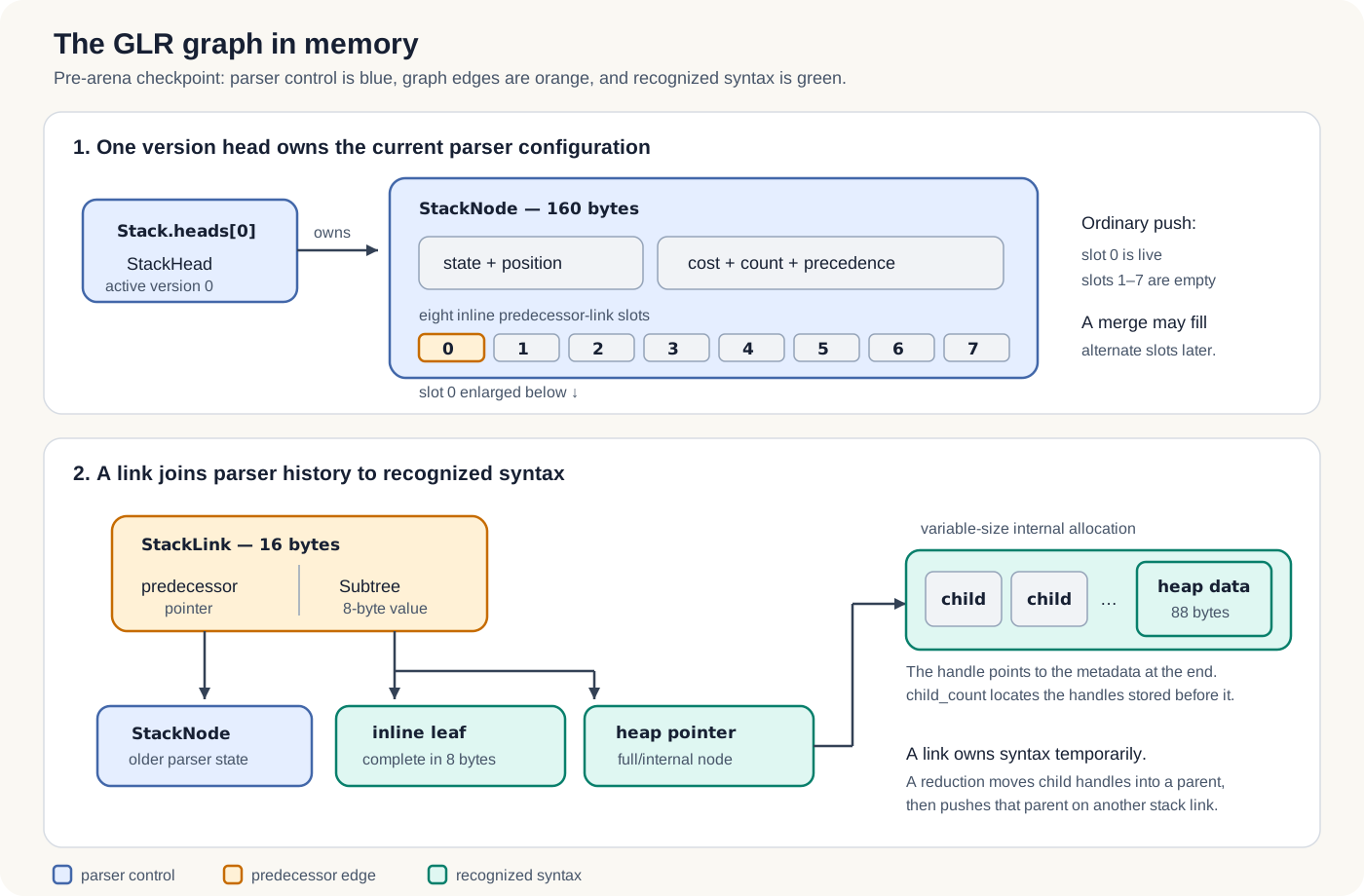
The most important detail is that syntax lives on the link, not in the stack node. Logically, the parser moves forward like this:
predecessor state -- recognize this subtree --> current stateThe runtime stores that relationship backward:
current StackNode -- StackLink{subtree} --> predecessor StackNodeBackward links make a reduction natural: begin at the current head, walk toward older states, and collect syntax from the links along the way. They also allow sharing. Two histories can reach the same state and input position through different predecessors. One current node can keep both arrivals as two links, sharing the configuration that has the same future without erasing either past.
What a materialized stack node costs
At the measured checkpoint, a StackNode occupied 160 bytes:
StackNode — 160 bytes
+--------------------------------------------------------------+
| state | position | links[8] | link_count | ref_count          |
| error_cost | node_count | dynamic_precedence                  |
+--------------------------------------------------------------+

StackLink — 16 bytes
+----------------------------+
| predecessor pointer        |
| Subtree value              |
+----------------------------+
The eight inline link slots consumed 128 bytes. A normal push initialized all eight and then filled slot zero with its only predecessor. The other seven were reservations for a merge that, according to the audit, almost never arrived.
The remaining fields are cached facts about the complete path ending at that node. stack_node_new copies the predecessor's input position, error cost, visible-node count, and dynamic precedence—a grammar-provided preference used to rank competing parses—then adds the new subtree's contribution. Version comparison and lexer positioning can therefore read the answer from the top instead of walking the whole history.
StackNode::ref_count tracks ownership inside the stack graph. A version head or a successor link can keep a node alive. Because this graph is mutated only by its parser, the current Rust implementation uses an ordinary integer rather than an atomic counter. When the count reaches zero, release walks backward, releasing link subtrees and predecessor nodes. Up to fifty dead node blocks sit in a small reuse pool; excess blocks return to the allocator.
That pool saves some allocator calls. It does not save rewriting the 160-byte record or performing the ownership transfers. Reusing the suitcase still means packing all eight pockets.
The action interpreter decides what happens next
parser_advance advances one version. It begins with three facts cached in the head: parser state, input position, and the most recent token from grammar-specific scanning code. From there it obtains a lookahead—the next token, not yet consumed—and asks the generated grammar table what to do for (state, lookahead).
A shift consumes the lookahead and returns to the outer parse loop. A reduction does not consume it. The parser builds a parent, enters the grammar's goto state—the table's answer for what follows that completed construct—and asks the table about the same lookahead again. Several reductions can therefore happen before the next token moves at all.
The current interpreter has a direct path for a table entry with one action. A multi-action entry enters the general dispatcher and materializes the deterministic window first, because several valid actions may create topology that a linear array cannot express.
one version + one lookahead
          |
          v
  table(state, symbol)
      |           |
    shift       reduce
  consume token  keep token, change state, consult table again
      |
  accept / pause / recover / continue
Shift: put one recognized token on one edge
The lexer returns a leaf Subtree. parser_shift normalizes its extra flag if necessary and calls stack_push with the next state.
On the generalized path, stack_push creates a StackNode. Link zero points to the old head and carries the token subtree; the version head moves to the new node. The old node is not copied. It remains the shared past.
before:
head -> state 14

shift identifier, next state 27

after:
head -> state 27 --{identifier leaf}--> state 14
With the deterministic window enabled, the same shift appends a compact entry instead. The graph node above exists only if a later operation materializes the window.
Conflict: versions name futures, links preserve pasts
When the grammar permits several actions, Tree-sitter must preserve several possible futures. It represents each current possibility with a StackHead. Creating another version retains the same current node rather than copying all nodes beneath it.
version 0 head --+
                 +--> shared current node --> shared history
version 1 head --+
The versions can then advance differently. Reductions can also discover several valid backward paths through a node with multiple links; each distinct pop result receives a version anchored at the predecessor where that path ended. The head array is therefore the changing frontier. The graph below it is the persistent history shared by that frontier.
Recovery uses version copying too, but for a different reason: it tries several ways to resume progress and later ranks or merges the results. The representation is the same even when the source of nondeterminism is a syntax error rather than a grammar conflict.
Reduce: enumerate backward paths, then build parents
A reduce action contains a grammar symbol and a child count. On the generalized path, parser_reduce first asks stack_pop_count for every valid path containing that many non-extra syntax values.
The pop is a depth-first traversal implemented by stack_iter:
- Start one iterator at the selected version's head node.
- Follow links backward and collect each link's subtree.
- When a node has alternate links, clone the iterator state for those paths.
- Count ordinary syntax toward the reduction length. Whitespace, comments, and other grammar-designated extras travel with the result without counting as the requested children.
- At the requested depth, reverse the collected handles into source order and return a
StackSlice. - If different paths end at different predecessor nodes, create a version for each distinct endpoint.
The retained subtree handles in each slice keep the children alive after the old stack ownership is released. This is the retain/release pair that looked so suspicious in a deterministic parse: it is necessary for a branching graph, but cancels itself when there was only one path.
For each result, the parser removes trailing extras, constructs the parent subtree, and asks the grammar's goto table for the state reached after that parent. It pushes the parent, then pushes any trailing extras back above it.
head -> S3 --{right child}--> S2 --{left child}--> S1
                 reduce two children
                           |
                           v
head -> goto(S1, Parent) --{Parent(left, right)}--> S1
If several graph paths produce competing child lists for the same reduction, Tree-sitter compares how much error recovery they required, the grammar's preference between them, and their structure before retaining the preferred parent. If reductions create additional versions, those versions are later renumbered or merged into the active frontier.
Merge: share the future without forgetting the alternatives
Two active versions can merge only when their current configurations are compatible: the same state and byte position, the same error cost, and equivalent state from any grammar-specific scanner. Those checks matter because a merge promises that both versions can make the same decisions from now on.
stack_merge keeps one current node and adds the other node's predecessor links to it. It does not link one current node to the other; that would invent a parser step that never occurred.
before:

head A -> current A --{tree A}--> past A
head B -> current B --{tree B}--> past B

after:

head A -> shared current --{tree A}--> past A
                         \--{tree B}--> past B
stack_node_add_link rejects duplicate links, recursively combines equivalent predecessor configurations, retains genuinely new predecessors and subtrees, and caps the inline alternatives at eight. The second head is then removed. Later reductions see both histories by following both links.
This is the heart of the graph-structured stack: sharing happens at a parser configuration with a common future, while the incoming edges preserve the different syntax histories that reached it.
Pause, reject, recover, and release
A version with no valid action is first paused, not immediately destroyed. If another version advances successfully, condensation can discard the paused one. If every promising version is paused, Tree-sitter resumes the best one and enters error recovery.
parser_condense_stack is the frontier's customs desk. This cleanup and ranking step—called condensation—removes halted versions, compares versions by recovery cost and progress, merges compatible ones, caps the number of survivors, and decides whether a paused version must be recovered or can be discarded.
Removing a version releases its StackHead. That decrements the top node's reference count. If it reaches zero, stack_node_release releases every link's subtree and predecessor reference, then continues backward through nodes that also become unreachable.
This is why rejecting one GLR version can release an entire speculative syntax branch. The stack links were its owners. Shared nodes and subtrees remain alive because another head, link, or syntax parent still refers to them.
There are therefore two separate ownership systems:
- stack-node references keep possible parser histories alive;
- subtree references keep recognized syntax alive.
They touch at StackLink::subtree, but they answer different questions. Mixing them up makes rejection look like accidental tree destruction. Separating them makes the release cascade exactly what it should be: the proof that no surviving parse can reach that speculative work.
Where the deterministic window fits
The optimized runtime does not replace this GLR implementation. It places a linear suffix above it:
materialized shared graph <- base node | compact deterministic entries -> headAs long as there is one active version and an operation needs no graph topology, shift and reduce work in that suffix. A conflict, recovery operation, graph walk, version mutation, or diagnostic logger first converts every entry into the equivalent StackNode chain. The generalized code then proceeds unchanged.
After condensation leaves one healthy active version, the window can begin again above the surviving materialized graph. The optimization is therefore not a second parser and not a restricted grammar mode. It is delayed payment: ordinary code avoids buying graph objects, while genuinely generalized code receives the exact graph it expected all along.