
How ast-grep Rewrote Tree-sitter in Rust and Made It 30% Faster
Part 1 of 4 — the complete adventure
ast-grep rewrote Tree-sitter in Rust. The current core is faster at parsing, faster at reading the completed tree, and faster in ast-grep itself.
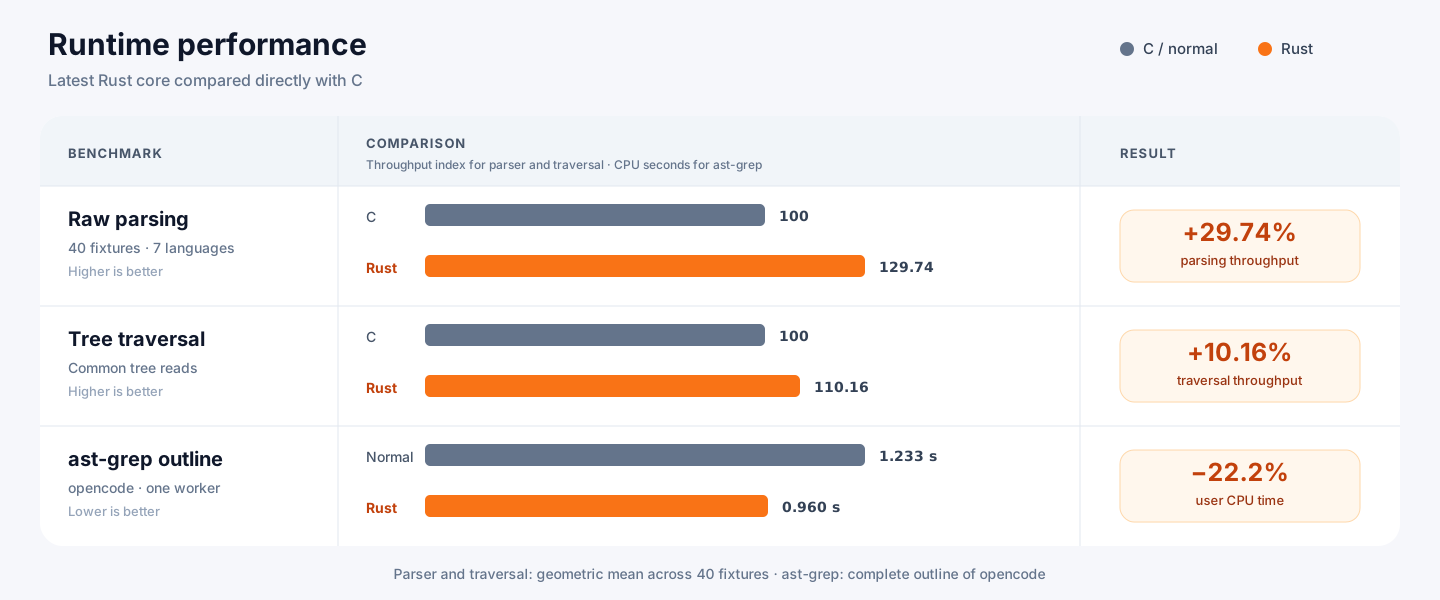
Performance and peak RSS
| Benchmark | C / normal | Rust | Difference |
|---|---|---|---|
| Raw parsing | Throughput: 100 RSS: 8.48–21.41 MiB | Throughput: 129.74 RSS: 8.42–25.70 MiB | +29.74% throughput +20.0% RSS upper bound |
| Tree traversal | Throughput: 100 RSS: 20.38 MiB | Throughput: 110.16 RSS: 22.20 MiB | +10.16% throughput +8.9% RSS |
| Complete ast-grep outline | User CPU: 1.233 s RSS: 26.52 MiB | User CPU: 0.960 s RSS: 34.43 MiB | −22.2% user CPU +29.8% RSS |
Rust won every parser and traversal fixture, and ast-grep produced exactly the same outline. Memory is the tradeoff: the Rust build uses about 8 MiB more in the ast-grep run. On the much larger TypeScript stress corpus, it peaks at 91.2 MiB.
That is the ending. Getting there was another matter.
Why Rewrite Tree-sitter?
Every serious ast-grep performance investigation eventually arrived at the same place: Tree-sitter.
ast-grep could make its rules faster. It could prune work, cache configuration, and avoid visiting irrelevant syntax. But every file still had to become a syntax tree first, and Tree-sitter built that tree. The parser was both the foundation and, increasingly, the ceiling.
I had dreamed about rewriting or deeply optimizing it for years. The dream usually lasted until I opened the runtime. There was a mature C implementation, binary compatibility with generated languages, external scanners, error recovery, incremental parsing, ambiguous grammars, reference-counted trees, several language bindings, and a small matter of not breaking the enormous grammar ecosystem built on top of all of it.
For one person, this was not a weekend project. It was a Herculean task wearing a header file.
So nothing happened.
Then the stories started appearing. Bun described its AI-assisted Zig-to-Rust migration, while pgrust explored an AI-assisted PostgreSQL rewrite and Roc documented a Rust-to-Zig migration. None proved that rewriting Tree-sitter was wise. They showed that such experiments had become cheap enough for one person to attempt.
AI did not make the runtime smaller, and it certainly did not make parser theory less strange. It gave me enough leverage to ask the unreasonable question and get an answer before the decade ended.
So I instructed ChatGPT to rewrite Tree-sitter's C core in Rust.
The first rule was conservative: change the language, not the behavior. ChatGPT translated one part at a time, checking each step against the existing tests and real grammars. The public interface stayed compatible, and the first Rust version followed the C code closely enough to compare when something broke. Translate first. Redesign later.
The rewrite was only the beginning. As soon as the Rust core passed those tests, I gave ChatGPT another instruction: /goal improve the perf by 20%. It returned a version that the benchmarks said was roughly twenty percent faster. For one brief moment, this looked absurdly easy.
Then I tried to understand the code. I could not. The mechanical C-to-Rust port had accumulated layers of overlapping optimizations, and soon the parser began segfaulting. I now had a speedup I could neither explain nor trust. So the mission changed: stop optimizing, delete the features this AI-first runtime did not need, and rewrite the remaining C-style Rust into code I could reason about.
Only after that cleanup did I return to performance. Profiles and academic parser research led to two major changes: keep the common parser stack linear, and allocate syntax nodes from shared blocks of memory. That produced real parser gains—and then ast-grep became slower. The investigation had to expand beyond the parser benchmark into memory, tree traversal, and the complete application lifecycle. The parser, it turned out, was only the first half of the adventure.
The three posts after this one contain the layouts, algorithms, profiles, and failed candidates. This post is the entire adventure for everyone who quite reasonably does not want to spend an evening tracing parser memory by hand.
Tree-sitter's Parsing Architecture
Tree-sitter takes source code and produces a syntax tree. A lexer turns characters into tokens such as identifier, +, and number. The parser then uses a generated table and a stack to decide what each token means.
Most of the time, the table requests one of two operations:
- shift: consume a token and push it onto the parser stack;
- reduce: recognize that several syntax pieces form a larger grammar rule, replace them with one parent, and continue.
If every table entry had one valid answer, the parser could follow one history with one stack. That is the ordinary LR case. Programming-language grammars occasionally have genuine conflicts: more than one action may remain valid until additional input reveals which interpretation survives.
Tree-sitter therefore uses generalized LR (GLR). It can follow several histories at once while sharing their common past in a graph-structured stack. Think of one road that can briefly fork, then merge again. The graph is necessary when the grammar is ambiguous. It is considerably less charming when the parser constructs graph machinery for a road that remains straight.
The other central object is the subtree. A shifted token becomes a leaf; a reduction combines children into an internal syntax node. These values are created during parsing, shared across stack histories, published as the final tree, traversed by ast-grep, and eventually released. Optimizing only their birth while ignoring the rest of that lifetime would later produce a rather expensive lesson.
That is enough parser theory for the overview. The first technical deep dive builds the complete model from a tiny expression and follows it into GLR.
First Step: Preserve C Behavior in Rust
The first goal was not elegance. It was parity.
The rewrite contract was deliberately conservative:
- Use the existing tests as the behavioral oracle. A plausible Rust implementation was not enough; it had to produce the same trees, recovery behavior, navigation results, and public API effects.
- Test the ecosystem, not only handwritten examples. Existing generated grammars and external scanners had to keep working without regeneration or source changes.
- Preserve the binary interface (ABI). Generated language tables, public C functions, layouts, symbols, and calling conventions remained compatible while the implementation behind them changed language.
- Translate before redesigning. The first Rust version intentionally resembled the C control flow so parity failures had a bounded search area.
In one sentence: preserve everything the ecosystem can observe, then make the inside replaceable.
I instructed ChatGPT/Codex to translate the runtime one part at a time: basic utilities, tree storage, lexing, the parser stack, tree navigation, and finally the parser loop. The agent read the C and Rust code, wrote patches, fixed compiler errors, ran tests, and investigated mismatches. I supplied the goals, constraints, objections, and decisions. The existing implementation and test suite supplied the answer key.
This distinction matters. I did not personally type a heroic Rust port and then ask AI to polish the comments. The implementation, profiling, instrumentation, and much of the experimental code were produced by the agent under my direction. Without AI, this project would still be an idea I occasionally mentioned before wisely changing the subject.
The new core preserved the C ABI, generated parsers, external scanners, public tree behavior, and bindings. The first Rust implementation also preserved a great deal of the C implementation's shape. That was intentional: when parity failed, similar control flow made the difference findable.
The C core had become Rust. It compiled. It passed the tests. Existing grammars could use it. This was already the kind of result that had looked impossible when the project was sitting on the shelf.
Naturally, I immediately asked for more.
Why the First Optimization Attempt Failed
The target was vibe coding in its purest form. The method was more deliberate. I directed ChatGPT to use proper profiling tools, understand the runtime's data layouts and ownership, and look for algorithmic changes instead of merely polishing individual instructions. The agent traced those paths, proposed implementations, and produced patches across the stack, subtree storage, and parser loop. I chose the major directions; the agent explored and implemented them. But the code arrived faster than I could build a mental model of everything it was changing.
The performance measurements at the time said it had worked. They crossed the requested line: roughly twenty percent.
This should have been the triumphant ending.
Instead, I opened the code.
The parser was now a layer of AI-generated optimization over a mechanical C-to-Rust translation. The individual changes looked plausible. Together they were unreadable. I could not explain which ownership rule made a pointer valid, which fast path preserved GLR behavior, or which benchmark result belonged to which overlapping experiment. The number said “faster.” The code said nothing I could safely repeat.
Then the worst thing happened: segfaults.
Not a friendly Rust panic with a useful stack trace. Not a failed assertion pointing at an invariant. The process simply left. Somewhere inside a parser full of shared subtrees, compatibility boundaries, stack links, and optimized unsafe code, an address had become fiction.
What was I supposed to debug? I could not explain what the code was doing, let alone why it had decided to leave the process.
A parser that is twenty percent faster and occasionally disappears is not an optimization. It is a benchmark with a jump scare.
The performance number had arrived before understanding. That reversed the project. I stopped asking ChatGPT to make the pile faster and started asking it to make the system explainable.
Phase 2: Reduce Scope and Improve Readability
The cleanup had two parts:
- delete features and representations outside the target product;
- turn the retained C-style Rust into code whose ownership and control flow could be reasoned about locally.
Neither step promised a heroic benchmark. Both were prerequisites for trusting the next one.
Remove Incremental Parsing from the Target Runtime
At first, “rewrite Tree-sitter” implied preserving every feature. Then the target workload forced a better question: preserving it for whom?
Upstream Tree-sitter is famously useful inside editors. A human inserts one character, deletes two more, and expects highlighting to update before the next frame. Incremental parsing lets the runtime reuse the old tree and rebuild only the affected region. In that world, reparsing the complete file after every keystroke is needless work.
That was not the world of this branch.
ast-grep and the AI coding-agent tools I cared about operate on complete file snapshots. An agent reads a file, analyzes or rewrites it, and asks the tool to process the new snapshot. There is no editor-owned syntax tree advancing one keystroke at a time. A fresh parse is not a degraded fallback; it is the normal operation.
Once those workloads sat next to each other, the boundary became clear:
- Complete snapshots, not keystrokes. Fresh parsing would be the intended path, so editor-specific old-tree reuse did not belong in every core parser structure.
- Native tools set the performance target. The browser WebAssembly build remained, but native loading of Wasm-compiled language grammars was removed; neither defined this optimization workload.
- Keep the public contract stable. Existing callers could retain the same API even when this implementation stopped using an old tree during parsing.
So I decided to remove incremental old-tree reuse and instructed ChatGPT to do it. The public parameter remains for compatibility, but this runtime parses fresh. The machinery for finding and reusing pieces of the old tree disappeared from the hot implementation.
This is not a proposal that upstream Tree-sitter should abandon incremental parsing. It is a product decision for a narrower runtime aimed at file-at-a-time analysis and agent tooling. If this branch returns to interactive editor use, the decision must be reopened. That was the rule: delete only behind a declared boundary, never because a feature happened to be inconvenient.
Deletion turned out to be the first real optimization technique: remove work whose use case has already left the building.
Refactor the Retained Runtime for Maintainability
A line-by-line translation is only readable if the reader already knows the original line by line. I instructed ChatGPT to break the monolithic, pointer-heavy port into more idiomatic internal Rust—without making the ABI-facing types “idiomatic” in ways that would break existing grammars.
The cleanup followed another small set of rules:
- Make ownership visible. Internal raw-pointer parameters became references or slices where their lifetimes were local and provable.
- Represent absence explicitly. Sentinel pointers and magic states became
Optionor named states. - Return values normally. Out-parameters became return values when the C ABI did not require them.
- Localize mutation. Large modules split by responsibility, and changes to state moved closer to the code responsible for that state.
- Hide density behind readable operations. Frequently copied tree references stayed compact, but pointer arithmetic and ownership rules acquired narrow APIs and names.
- Keep compatibility ugly where it is real. Generated-language layouts and exported functions remained C-shaped because another binary had already committed to that shape.
That cleanup made questions answerable: Who owns this piece of the tree? Can this reference survive when its storage grows? Why does one reduction create a temporary parser state only to delete it immediately?
The important output was not prettier syntax. It was a runtime organized well enough that a segfault, invariant failure, or suspicious allocation had an address in the architecture. Only then could performance work become more than high-speed archaeology.
GLR and Memory-Layout Optimizations
Once I could understand the runtime, I directed ChatGPT back toward reduction, the operation the parser performs constantly. A reduction takes a few pieces of syntax the parser has already recognized and combines them into one larger piece. For example, a, +, and b become an addition expression.
That small operation touches both major data structures. It removes the children from the parser's working stack, then stores them under a new parent in the syntax tree. The profile showed that Tree-sitter was doing much more work around those children than the ordinary case required.
The successful changes eventually fell into four simple principles:
- Avoid work for uncommon cases. About 99% of the observed parser stack was one straight path, so the parser no longer builds a graph until the input actually forks. Work needed mainly for editing is also kept out of a fresh parse when possible.
- Make allocation cheap, and references small. Asking the general-purpose allocator for every internal syntax node is expensive. An arena obtains a growing block and serves many nodes from it. Separately, compact references reduce the bytes moved between the parser stack and the tree.
- Do repeated work once. The parser prepares common grammar lookups ahead of time, and the tree reader avoids looking up the same children repeatedly.
- Give the simplest cases a short path. One parser action is handled directly, and ordinary ASCII input avoids the full character-decoding path. The complete fallback remains available whenever the simple path does not apply.
ordinary parse: keep one stack path
real ambiguity: switch to the full graph
The 99% number described the problem, but not the solution. I directed ChatGPT Pro to review academic work on generalized parsers, and the result pointed to an older lesson: do not build the general structure until the input actually needs it. The arena was a separate idea and required its own experiments. The linear stack avoided graph bookkeeping; the arena reduced calls to the general allocator. Making references smaller was yet another layout choice, and it did not become faster automatically. Several versions lost before the pieces paid for themselves.
The exact representations and failed alternatives belong in the later posts. The important result here is simpler: ordinary parsing stopped paying the full price of rare ambiguity and separate allocation for every internal syntax node.
For a moment, the parser benchmarks looked excellent.
Then I asked ChatGPT to build ast-grep against it.
End-to-End Performance Findings
The agent ran that binary across opencode, a real TypeScript repository. At that historical checkpoint, the parser-only benchmark put this Rust implementation roughly 30% ahead of the C runtime.
The application was slower.
How could a parser become thirty percent faster while the application became slower?
The parser benchmark had reused one parser. ast-grep created parsers for thousands of files, then walked every completed tree to extract its outline. The benchmark had measured only the middle of that journey.
The first arena reserved a huge virtual memory region every time a parser was created. It did not immediately consume all that physical memory, which had made the design look harmless. Across a repository, however, reserve and release happened thousands of times. I directed ChatGPT to replace it with an ordinary small allocation that grew only when needed.
The CPU regression appeared in the ast-grep benchmark that used the opencode repository as its corpus. The memory sequence below used a separate TypeScript stress corpus with one ast-grep worker, held constant from the first 1.04 GiB result through the final 91.2 MiB result.
That removed one problem and exposed another. Old arena blocks remained alive when the storage grew, pushing a serial run to 1.04 GiB of memory. ChatGPT changed the internal references so the arena could move as it grew and the old blocks could be released. The peak fell to about 492 MiB.
Still far too much.
The obvious suspect was dead syntax nodes. I directed ChatGPT through two attempts to reclaim them; neither changed the result. Only after I asked the agent to count memory by purpose did the real answer appear: 468.2 MB belonged to temporary child buffers, not the tree nodes I had told it to reclaim. The agent reused those buffers and brought the peak down to 91.2 MiB.
The completed tree had one more surprise. Compact indexes helped while building it, but ast-grep had to look them up while reading it. Some parser time had simply moved into tree traversal. ChatGPT changed the tree reader to look up each group of children once instead of repeatedly, recovering that cost.
The end-to-end failure did not invalidate the parser work. It invalidated the old meaning of “worked.” From then on, a performance result needed to cover parsing, memory, reading the tree, and the complete application lifecycle.
There was no single magic patch behind these results. Some changes saved parser time, some prevented a memory disaster, and others recovered time while reading the completed tree. The detailed posts and performance ledger separate the individual experiments; this overview keeps the principles that connect them.
Lessons from the AI-Assisted Rewrite
At the beginning, AI increased the amount of code a single instruction could set in motion. That was enough to make the rewrite possible and nowhere near enough to make it good.
The early loop looked like this:
/goal improve the perf by 20%
        -> a great deal of plausible code
        -> a confusing benchmark
        -> another plausible patch
Later it looked like this:
find the expensive work
        -> explain why it happens
        -> change one mechanism
        -> compare with the previous Rust revision
        -> test the complete application
        -> retain, revise, or reject
ChatGPT/Codex did not gradually become infallible. I gradually learned enough about the runtime to give it narrower problems, challenge bundled assumptions, and demand evidence at the correct boundary. The segfaulting early speedup, the arena's memory explosion, and the slower application all arrived behind reasonable-looking code and encouraging local results. Profiles and tests had to be less impressionable than either participant.
By the end, the collaboration had found its proper division of labor. ChatGPT could explore implementation space at a pace I could never match by hand. My job was to keep narrowing the question until profiles, invariants, and end-to-end controls could answer it. Speed made the expedition possible; evidence decided which parts returned.
That is the whole adventure. The remaining posts slow it down:
- The C-to-Rust migration, feature scope, and readability rewrite explains LR/GLR carefully, decides what this branch retains, and shows how the compatibility boundary survived.
- The simplification and performance campaign explains why the parser built a graph for an almost-always-linear workload, then follows the many decisions hidden inside “use an arena.”
- The ast-grep reality check contains the memory traces, traversal investigation, benchmark rules, and final performance lessons.
The short version is that AI gave me a chance to move the load-bearing wall. The rest of the project was discovering, one benchmark at a time, which roof beam had come with it.